Will this Christmas…Change their lives again?
When self-made gentleman Freddie Walton rescued penniless Philomena Nichols at Christmas eight years ago, he never imagined that he would build his empire with her. Yet whilst they have created a life together as friends, Freddie can’t let their special connection become more than that. Not when his dangerous past continues to haunt him… But what happens when Freddie’s feelings for Philomena refuse to stay hidden?
Lotte James trained as an actor and theatre director but spent most of her life working day jobs crunching numbers whilst dreaming up stories of love and adventure. She’s thrilled to finally be writing those stories, and when she’s not scribbling on tiny pieces of paper, she can usually be found wandering the countryside for inspiration or nestling with coffee and a book.
After years of travel, Freddie Walton has finally put down roots and purchased a building to not only open his business but also as a place to live. He is inspecting the property when he comes upon a half-starved, terrified girl. He invites her in to eat and get warm, knowing that he can’t turn her away, but not realizing how this decision will ultimately change his life.
Philomena “Mena” Nichols has come a long way from the ragamuffin that was saved that December night by Freddie. She has worked hard with Freddie to make his business a success and has also worked diligently to improve herself and despite her lingering fears, has managed to do amazing things on her own.
Freddie and Mena have a complicated relationship and are often apart from each other, they are both self-made people, and both feel inferior, even though Freddie has a circle of friends in high society and is welcomed into the ton, they both think they are unworthy. Even after their relationship changes and they become lovers, they still don’t believe they are deserving of a HEA with each other and struggle with feelings of inadequacy. Especially Freddie, whose past is coming back to haunt him.
This was an odd read for me and I wonder if it was because this is the third book in the series and I didn’t read the previous books. While the idea of the book intrigued me when I started reading it, there were things that I found offputting, such as Freddie’s relationship with Lady Mary, they were just a bit too cozy for my liking, and in this era, there is no way they could spend as much time together as they did without controversy or risk to Mary’s reputation. I also wasn’t a fan of Freddie’s resistance to committing to Mena, or the fact that he knowingly hurt her. OK – I guess, I was just not a fan of Freddie in general. Overall, I thought the book had potential but was a bit too repetitive and slow-moving, and I certainly wouldn’t classify it as a “Gothic Romance”.
*I am voluntarily leaving a review for an eARC that I requested and was provided to me by the publisher. All opinions in this review are my own.*
In the tradition of C. S. Harris and Anne Perry, a fatal disaster on the Thames and a roiling political conflict set the stage for Karen Odden’s second Inspector Corravan historical mystery.
September 1878. One night, as the pleasure boat the Princess Alice makes her daily trip up the Thames, she collides with the Bywell Castle, a huge iron-hulled collier. The Princess Alice shears apart, throwing all 600 passengers into the river; only 130 survive. It is the worst maritime disaster London has ever seen, and early clues point to sabotage by the Irish Republican Brotherhood, who believe violence is the path to restoring Irish Home Rule.
For Scotland Yard Inspector Michael Corravan, born in Ireland and adopted by the Irish Doyle family, the case presents a challenge. Accused by the Home Office of willfully disregarding the obvious conclusion and berated by his Irish friends for bowing to prejudice, Corravan doggedly pursues the truth, knowing that if the Princess Alice disaster is pinned on the IRB, hopes for Home Rule could be dashed forever.
Corrovan’s dilemma is compounded by Colin, the youngest Doyle, who has joined James McCabe’s Irish gang. As violence in Whitechapel rises, Corravan strikes a deal with McCabe to get Colin out of harm’s way. But unbeknownst to Corravan, Colin bears longstanding resentments against his adopted brother and scorns his help.
As the newspapers link the IRB to further accidents, London threatens to devolve into terror and chaos. With the help of his young colleague, the loyal Mr. Stiles, and his friend Belinda Gale, Corravan uncovers the harrowing truth—one that will shake his faith in his countrymen, the law, and himself.
ADVANCE PRAISE
“[An] exceptional sequel . . . Fans of Lyndsay Faye’s Gods of Gotham trilogy will be enthralled.” —Publishers Weekly, starred review
“Victorian skulduggery with a heaping side of Irish troubles.” —Kirkus Reviews
“Charismatic police superintendent Michael Corravan is back in a gripping sequel about the mysterious sinking of the Princess Alice. Odden deftly weaves together English and Irish history, along with her detective’s own story, in a way that will keep readers flipping pages long into the night.” —Susan Elia MacNeal, New York Times bestselling author of Mother Daughter Traitor Spy and the Maggie Hope series.
Having finished writing my daily report, I left Wapping, walking past the London Docks to Sloane Street, where the Goose and Gander stood at the corner of Hackford.
The sight of it brought back the afternoons Pat Doyle and I would come here, our spirits buoyed by the shillings in our pockets from working on the docks. We steered clear of most public houses—like the English Pearl, a few doors down, or the Drum and Thistle—but we two Irish stevedores found a welcome here, in this low-ceilinged room with a pair of rusted swords and a Celtic Cross over the mantle. Joining in on the bawdy choruses after a few pints made Pat and me feel like men—Irish men—and, for a while, as if we belonged. I’m not proud to admit it, but I liked it when someone who wasn’t Irish was scowled out of the place.
Life was hard on the docks. The dockmaster, named Smithson, always hired Pat and me as a pair because he knew that together we could accomplish four times what any other single man could. It didn’t keep Smithson from treating us the worst, though. If there was a swan-necked cart with a wheel that wasn’t working properly, that would be ours for the day. If we took time to fix the wheel, our wages would be docked. Sometimes we didn’t get a cart at all and had to haul the goods on our backs. If a bag of tea burst because it was roughly handled or at the bottom of a heavy pile, we’d be blamed. Pat and I kept to ourselves, mostly, though after a time we banded with a few older Irishmen who were hired regularly. We did our work, held our heads down, stayed out of people’s way. Still, most days Smithson would shout at us for being feckin’ Irish eejits, which worried me because Pat was quick to throw down whatever bag he was toting in order to free up his fists, and I’d have to remind him that we needed the money more than we wanted Smithson to pay for his spite. I hated it too. But we had no choice but to stay and take it.
It was the docks that taught me what being Irish meant because growing up in my part of the Chapel, Irish was all I knew. Like hundreds of others during the famine years, my parents sailed from Dublin to Liverpool, making portions of that city along the Mersey River more Irish than English. My father was a silversmith, and a skilled one, but there wasn’t enough work for all the silversmiths who had landed in Liverpool, so he and my mum came down to the Irish part of Whitechapel. With anti-Irish feeling running high, shops elsewhere in London wouldn’t hire a man with black hair and blue eyes named Corravan, with an accent straight out of County Armagh. My mum never told me so, but my father did what many Irishmen had to do—plied their trade sideways. He became a counterfeiter, making two-bit coins in a cellar somewhere, with fumes that clung to him when he came through our door at night. He died when I was three years old, too young to remember him well, but old enough that the odor of suet and oil and the bitter tang of cyanide had rooted itself in my brain. During one of my earliest cases in Lambeth, I walked into a house and recognized the smell straightaway, like I knew the smell of tea or hops or onions. That’s when I realized how my father had put bread on our table.
The rancor against the Irish grates at me sometimes. Not to say we don’t deserve some of it. Four years ago, two Irishmen in Lambeth threw firebombs into one of Barnardo’s English orphanages, to protest that Parliament had just prohibited the Irish from setting up orphanages for our own. The next morning, the corpses of twenty-six children were laid out on the street and on the front page of every newspaper in London. For weeks after, shame hacked at my insides. I could barely meet anyone’s eye.
But we Irish don’t all deserve to be tarred with the same brush, and it’s hard to bear the ugly opinions printed in the papers. Nowadays, I stop reading if I catch a hint of hatred in the first lines, but there was a time when I would read the articles and letters from “concerned citizens” and “true Englishmen” because I wanted to know the worst that could be said of us. That was before I realized that words could be infinitely malicious. There was no worst; there was only more. I still remember the conclusion of one letter because it seemed so preposterous: “The Irish are the dregs in the barrel, the lowest of the low. They kill their fathers, rape their sisters, and eat their children, stuffing their maws with blood and potatoes indifferently, like wild beasts.”
Well, that wasn’t true of any of the Irish I knew. Indeed, as I laid my hand on the doorknob of the Goose and Gander, I was reasonably certain that inside I’d find Irish folks sitting, eating normal food, and playing cards.
I pushed open the wooden door, greeted the barmaid, and asked if O’Hagan had been in. She shook her head. “Not yet. He usually comes around eight.”
Karen Odden earned her Ph.D. in English from New York University and subsequently taught literature at the University of Wisconsin-Milwaukee. She has contributed essays to numerous books and journals, written introductions for Victorian novels in the Barnes & Noble classics series, and edited for the journal Victorian Literature and Culture (Cambridge UP). Her previous novels, also set in 1870s London, have won awards for historical fiction and mystery. A member of Mystery Writers of America and Sisters in Crime and the recipient of a grant from the Arizona Commission on the Arts, Karen lives in Arizona with her family and her rescue beagle Rosy.

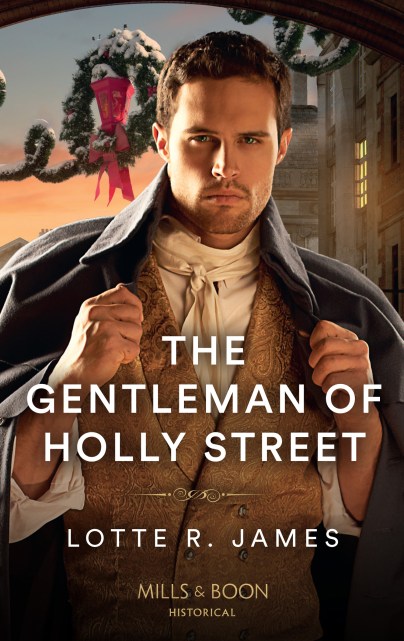


 The Gentleman of Holly Street by Lotte R. James


